

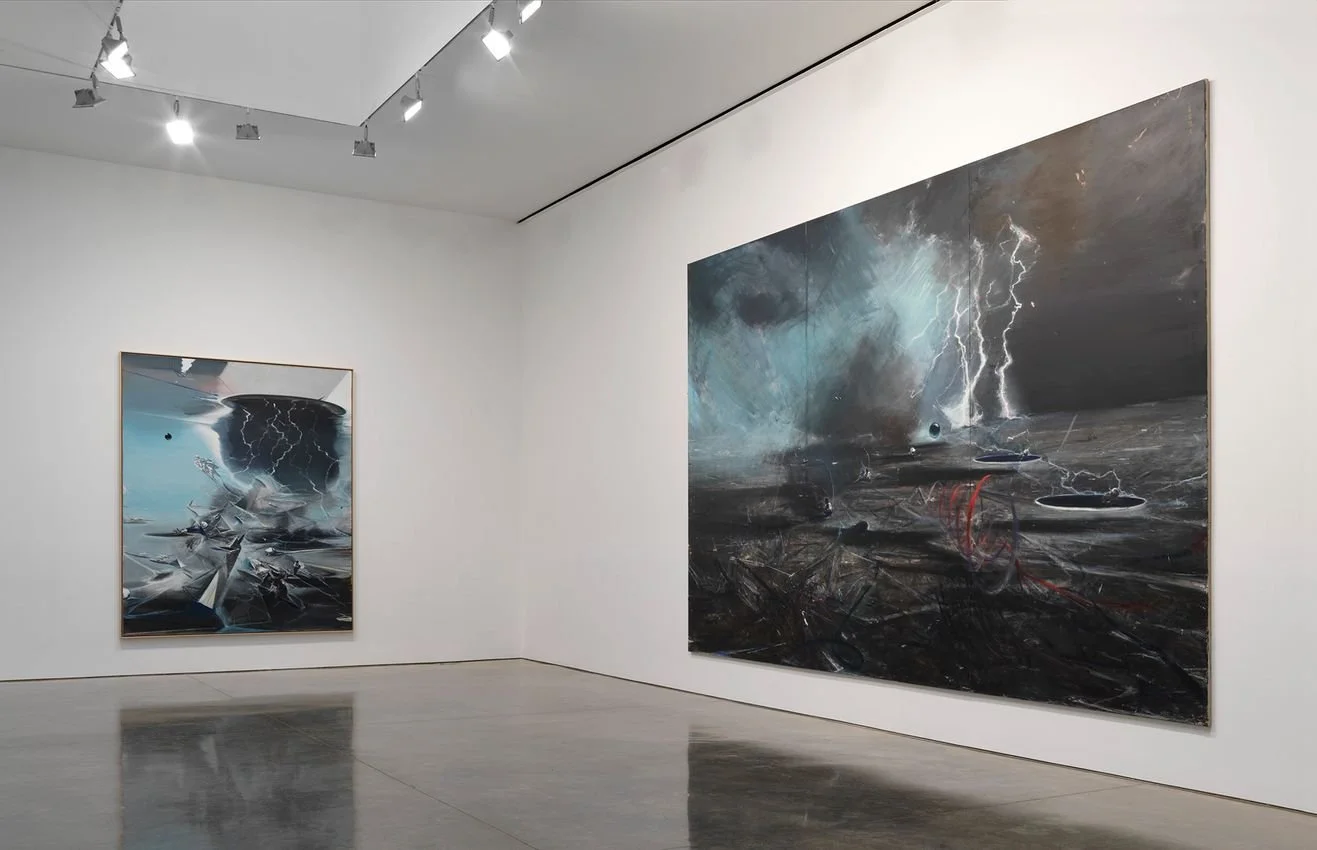
Hermit from the Planet, 2015-2016, Oil on canvas, 157 1/2 x 236 1/4 in. Courtesy of Gagosian.
Written by / @claroconcetto
Jia Aili: Combustion
Gagosian, New York, March 7–April 13, 2019
The exhibition stages encounters between painterly virtuosity and genuine disquiet. Twenty-nine works spanning a decade reveal Jia Aili developing a distinctive visual language—apocalyptic romanticism filtered through Chinese experience of radical transformation. The paintings operate in the space between historical painting's grand narratives and contemporary anxiety's fragmentary expression.
Hermit from the Planet (2015-16) anchors the exhibition's dark register. Three small figures against vast, cracked earth create crushing spatial dynamics—the human reduced to insect scale beneath atmospheric violence. The lightning strikes don't merely illuminate; they seem to tear through the picture plane itself. Jia achieves something rare: genuine pictorial dread. The Sputnik-like sphere floating above isn't kitsch sci-fi reference but formal punctuation—a perfect circle interrupting chaos, suggesting surveillance or alien indifference.
The material handling deserves attention. In the earlier Wasteland series, Jia builds surfaces through accumulation—thick paint creating topographical darkness that photographs can't capture. Standing before these canvases, you experience their physical density, the way black paint seems to absorb gallery light rather than reflect it. The hazmat-suited figures emerge from this darkness like fever dreams, their bulbous forms both comic and terrifying. This material density becomes critical: paint applied with such weight that it seems to drag the canvas downward, creating gravitational pull toward disaster.
By 2018-19, the work undergoes crucial transformation. Sonatine's four panels abandon singular narrative for what Jia calls "visual unfolding"—polyhedrons containing "autonomous scenes" that resist sequential reading. This fragmentation reflects contemporary consciousness: multiple catastrophes occurring simultaneously, each disaster interrupting another before resolution. The bright colors—electric blues, violent oranges—don't provide relief but intensify the hallucinatory quality. These aren't the colors of hope but of fever, of systems overheating.
The recurring "fanged purple sphere" demands reconsideration. Rather than dismissing it as video game reference, recognize how Jia metabolizes global visual culture—Nintendo aesthetics and nuclear anxiety occupying the same pictorial space, childhood play and adult terror rendered indistinguishable. These forms operate as syntactical disruptions, moments where representation collapses into pure shape, forcing constant recalibration of pictorial space. They prevent comfortable viewing distance, keep the eye moving, deny rest.
Frozen Light (2017) demonstrates Jia's technical range. The crystalline fragmentation suggests Analytical Cubism pushed toward entropy—space doesn't just fracture but freezes mid-explosion. Where Cubism sought to represent multiple viewpoints simultaneously, Jia represents multiple disasters simultaneously. The painting captures specific contemporary sensation: information overload experienced as physical paralysis, the moment when too much input creates stasis rather than action.
The Bacon comparison requires precision. Bacon's figures writhe in existential isolation, their screams emerging from internal violation. Jia's figures exist within environmental catastrophe—the terror isn't generated by consciousness but surrounds it, penetrates it, determines it. This shifts painting's relationship to trauma: from expressing subjective anguish to mapping objective conditions. The disaster isn't psychological but atmospheric, not personal but structural.
Consider how Gagosian stages this apocalypse. The installation photos reveal careful choreography: a skeleton sculpture positioned before massive storm paintings, scattered debris on polished floors, an armchair facing destruction. This isn't neutral presentation but theatrical direction—disaster as contemplative experience, catastrophe as meditation object. The viewer literally sits in comfort before acquired apocalypse, the end times safely contained within property rights.
Sonatine represents the exhibition's culmination and complication. Its scale—nearly 33 feet—creates immersive experience, but immersion into what? Walking its length, you don't read narrative but experience temporal collapse, where multiple moments exist simultaneously without synthesis. The eye can't hold the whole; attention fractures across competing incidents. This is painting as duration rather than image, process rather than product.
The Chinese context operates specifically. These aren't generic apocalypses but particular transformations—Jia's generation witnessing China's industrial revolution compressed into decades, environmental destruction and technological progress occurring simultaneously. The paintings process this specific vertigo: not gradual modernization but violent temporal compression, centuries of change in single lifetimes. The "dramatic modernization" isn't metaphor but lived experience of time itself accelerating beyond human scale.
What disturbs in Jia's work isn't the apocalyptic imagery but its beauty. These catastrophes seduce through color, composition, surface. We're drawn to examine disaster closely, find pleasure in its formal resolution. This recognition—that catastrophe has become our permanent aesthetic condition—manifests formally in how Jia's blacks aren't voids but substances, how his explosions create pattern rather than chaos, how destruction generates composition.
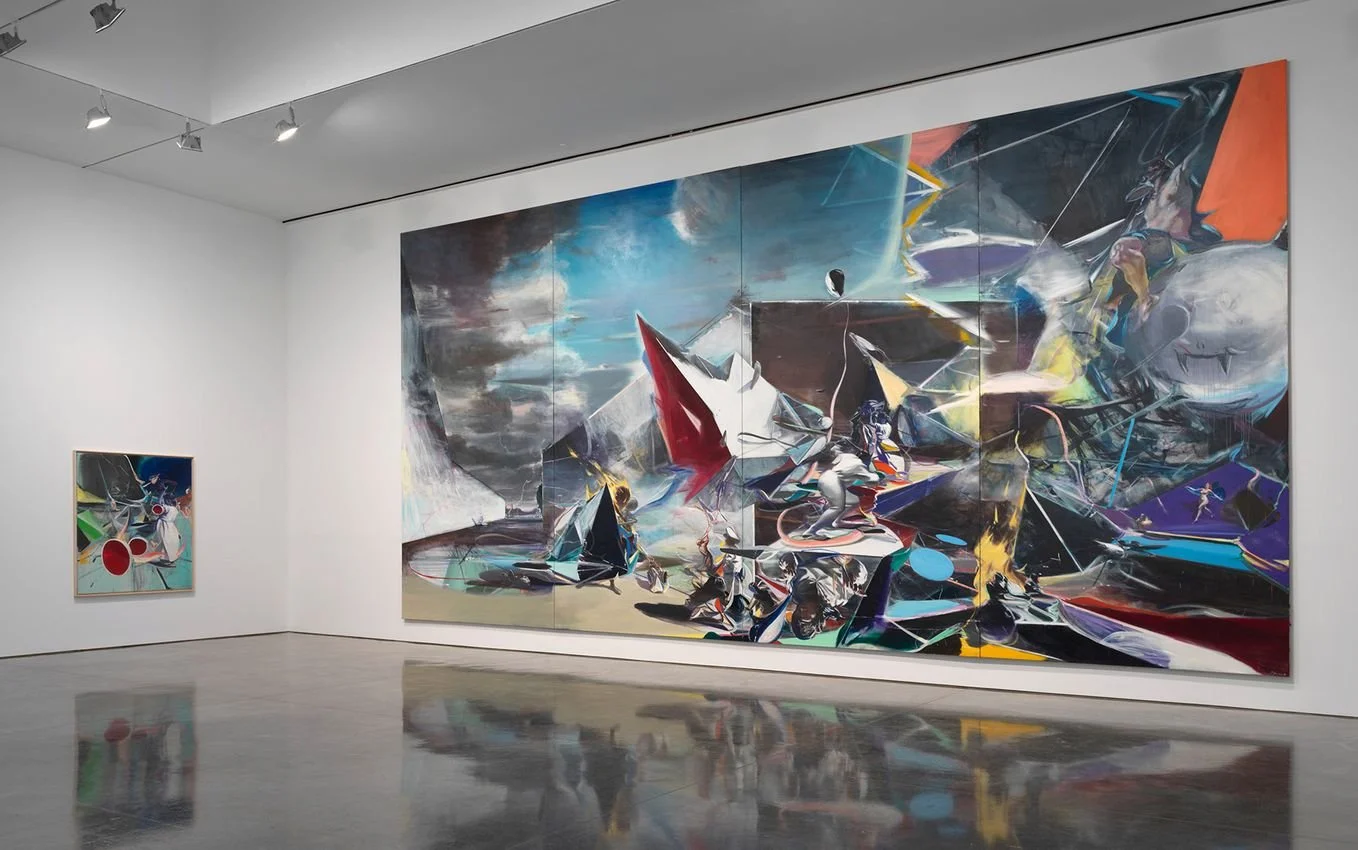
Sonatine, 2019. Oil on canvas, in 4 parts, 196 7/8 x 394 7/8 in. Courtesy of Gagosian.
The paintings' material density creates friction against gallery slickness. Their physical weight—paint accumulated until canvas sags—resists the weightlessness of digital circulation. The surfaces demand proximity, reveal details invisible in reproduction. This stubborn materiality represents painting's remaining power: its requirement of bodily presence, its resistance to complete digitization, its insistence on physical encounter.
Yet the commercial context can't be dismissed. The polished concrete floors that reflect Jia's painted disasters create uncanny doubling—the institution literally mirrors apocalypse back to itself. This isn't beautification but something more disturbing: recognition that our spaces for contemplating crisis are themselves products of the systems generating crisis. The gallery doesn't contain the apocalypse; it's part of the same continuum.
The strongest works—Hermit from the Planet, Frozen Light, sections of Sonatine—achieve what contemporary painting perhaps must: not escape from compromised conditions but aesthetic investigation of what creating within them means. They don't resolve the contradiction between disaster and beauty, critique and commodity, authentic expression and market calculation. Instead, they make these contradictions visible, material, undeniable.
The weakest works are those that lean too heavily on legible symbolism—obvious mushroom clouds, skeletons grasping burning shadows. Jia is strongest when allowing painterly process to generate meaning rather than illustrating concepts. When the material itself carries darkness—through density, absorption, accumulation—the work exceeds both commercial framework and critical interpretation.
What "Combustion" ultimately demonstrates is painting's capacity to hold contradictions without resolution. The apocalypse arrives through commercial galleries because that's where culture happens now. Jia's work neither celebrates nor laments this condition but inhabits it fully—through paint that weighs down canvas, blacks that swallow light, fragments that refuse synthesis. The paintings don't transcend their context but reveal it as another system in collapse, another structure combusting in real time, another disaster we experience as beauty because we've lost the ability to distinguish between them.