

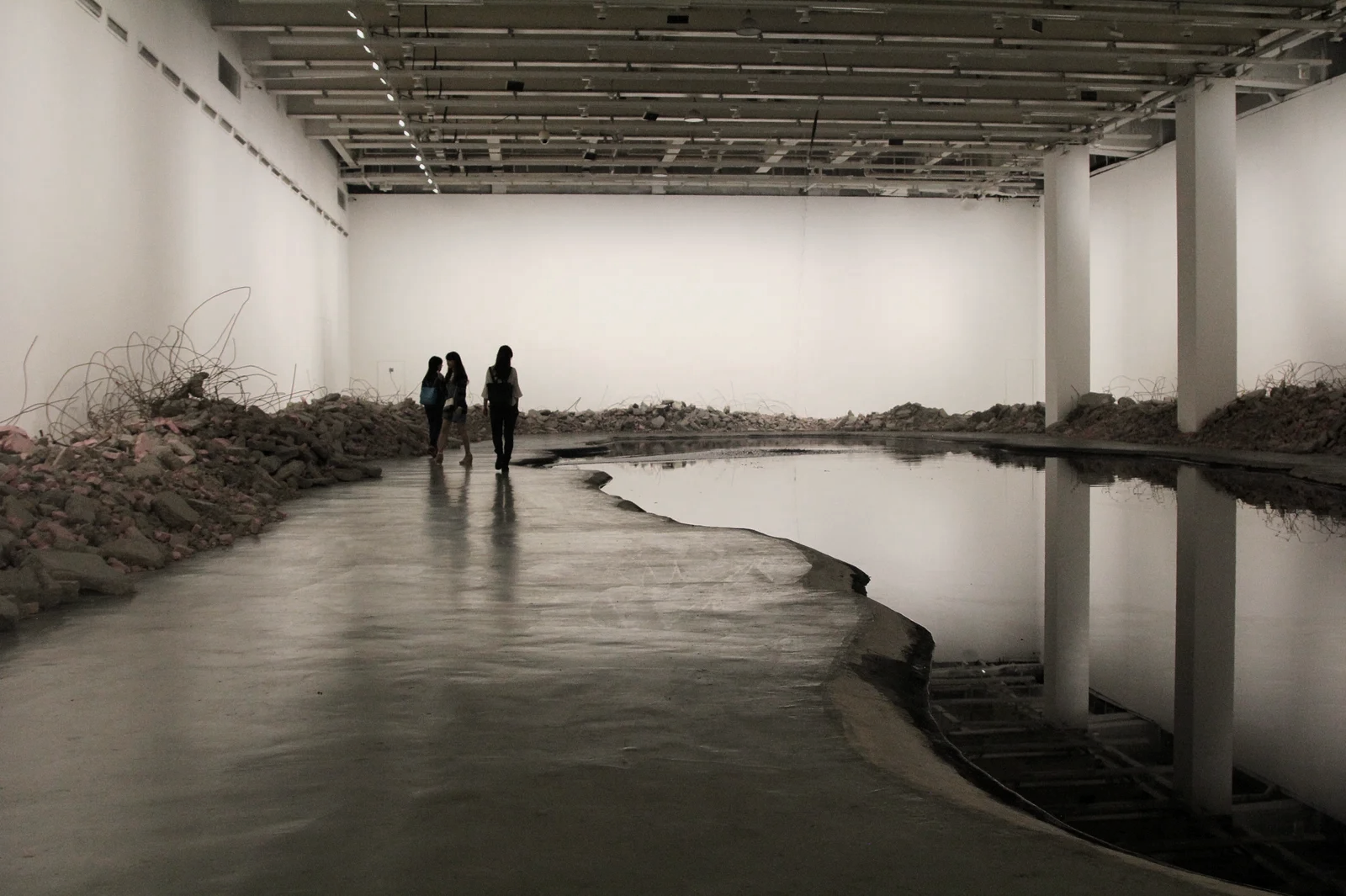
Silent Ink features a waterfall of ink plunging into a 5,300-gallon lake excavated from the museum's floor. Dimensions vary. Courtsey of NPR.
Cai Guo-Qiang: The Ninth Wave
Power Station of Art, Shanghai, 2014
The fishing vessel arrives already processed. Not just the boat—a working vessel from Quanzhou retrofitted as art object—but the entire apparatus of its reception. Before the first visitor enters, the work has been metabolized through state approval, curatorial framing, institutional programming. Li Xu, deputy director, reports that officials "liked it" because environmental discussion has become unavoidable. This liking constitutes the work's actual medium: not gunpowder or styrofoam but administrative enthusiasm for manageable critique.
The ninety-nine animals sprawled across the gunwales were fabricated in the same factories that produce China's export goods. Their exhaustion is manufactured—literally. Wool and styrofoam shaped into dying pandas, collapsed tigers, a depleted elephant. This isn't irony but accuracy. Cai commissions industrial production to represent industrial destruction, uses synthetic materials to mourn organic loss. The animals perform their sickness with the consistency only factory production ensures—each droop calibrated, every gesture of exhaustion quality-controlled.
Silent Ink excavates 250 square meters from the museum floor, filling the cavity with 20,000 liters of black ink. The posted warnings about overwhelming smell function as part of the work—announcing sensory assault as aesthetic experience. But the ink doesn't represent pollution; it performs a sanitized version, offering visitors homeopathic doses of environmental toxicity. Like vaccination, it introduces controlled exposure to produce immunity rather than infection. The work's title suggests contemplative quiet, but ink this black comes from industrial processing. The silence isn't peaceful—it's the muteness of the overwhelmed.
Consider the temporal mechanics. The work opened with Elegy, eight minutes of daytime fireworks—Cai's signature explosive medium deployed when it can't properly be seen. Fireworks in daylight become pure smoke, aesthetic pollution adding to Shanghai's already opaque air. The mourning performed here is preemptive, the elegy composed before the death, or rather, composed in the ongoing dying that never completes. This connects to Cai's The Bund Without Us, a 27-meter gunpowder drawing that imagines Shanghai's waterfront after human disappearance—except humans haven't disappeared, they've multiplied, intensified, accelerated.
Written by / @claroconcetto
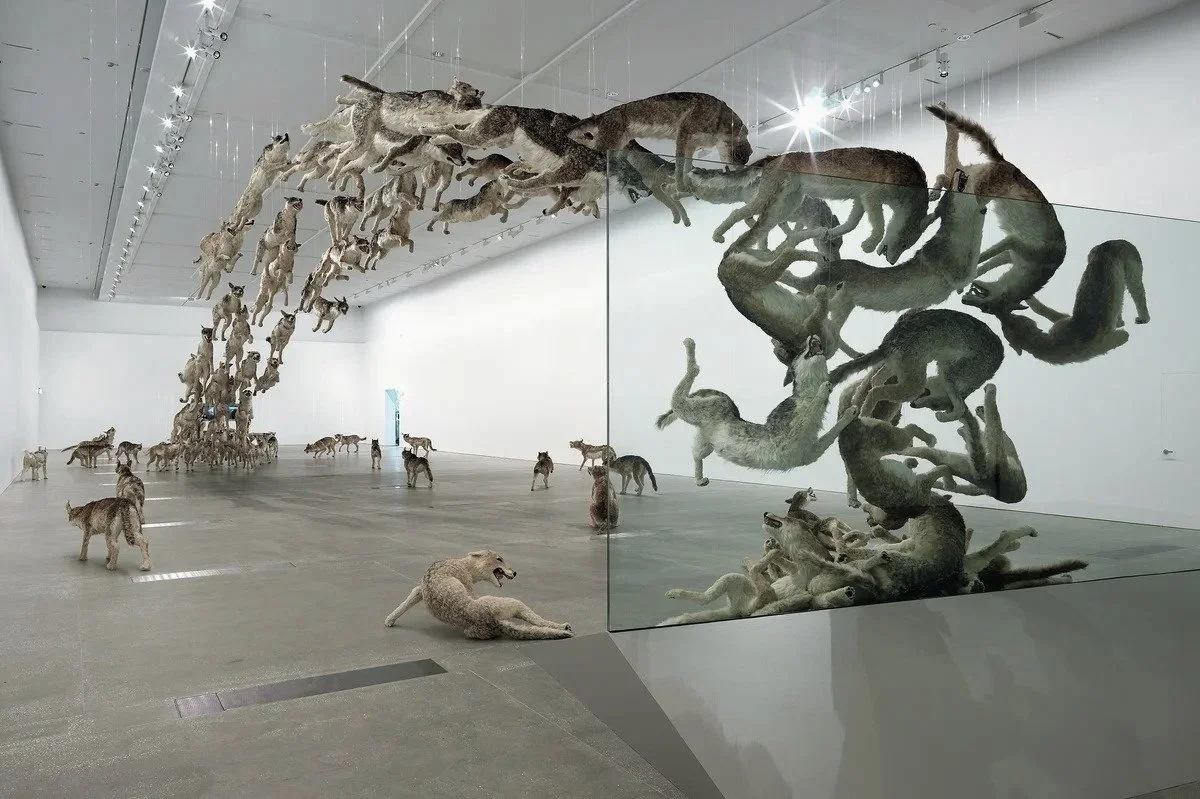
Head On. 99 life-sized replicas of wolves (gauze, resin, and hide) and glass wall. Dimensions variable. Courtsey of Cai Studio.
The reference work, Aivazovsky's 1850 The Ninth Wave, depicted human survivors after nature's violence. Cai's reversal should invert this power relation, but the inversion fails to complete. His animals never lived, can't properly die, exist in permanent states of synthetic exhaustion. The boat saves nothing because nothing aboard was alive to save. The white flag waves via electric fan—mechanical wind for prosthetic surrender, the capitulation automated, running on the same grid that powers the city's towers.
Head On (2006) reveals Cai's decade-long rehearsal of this formula. Ninety-nine wolves—the same count as the boat's animals—crash into a glass wall in perpetual loop. The piece predates The Ninth Wave by eight years, suggesting not evolution but repetition. The wolves never learn because learning isn't programmed. They perform ideological blindness, but the performance itself operates with perfect institutional sight. Each collision generates attendance, press coverage, acquisition interest. The crash becomes productive—of discourse, of value, of career.
Spring, Summer, Fall, Winter—gunpowder on porcelain—makes the contradiction material. Cai's explosive medium, which once suggested revolution, gets applied to luxury ceramics displayed behind museum glass. Four panels at 240 x 300 cm each, composed of tiles that reference both imperial pottery tradition and industrial modularity. The violence of gunpowder becomes surface decoration on objects that cannot be touched, only viewed through protective barriers. The seasons cycle but nothing changes—aesthetic time replacing ecological time, the porcelain preserving explosion as luxury commodity worth more than most annual salaries in China.
The exhibition's economy is precise: 20,000 visitors in opening weeks, each paying admission, purchasing catalogs, posting photos that become marketing. The Power Station of Art, converted from coal plant to culture palace, still processes resources into exhaust—cultural resources now, meaning as waste product. The smokestack-turned-thermometer measures temperature decoratively, the industrial architecture preserved as aesthetic frame. The building hasn't transcended its function but aestheticized it.
The 2013 pig incident that partly inspired the work reveals the actual system. Sixteen thousand carcasses in the Huangpu River weren't metaphor but logistics—disposal infrastructure unable to process production volume, farmers choosing efficiency. The pigs floated past the same financial towers the art boat would later pass. From those heights, pigs and art boats are equally invisible, equally irrelevant to capital flows that recognize only what can be monetized. Cai's procession transforms abject reality into spectacular commodity—the surreal made consumable, disaster made visitable during museum hours.
Pan Ting, the young poet interrogated for discussing the pig incident, represents what Cai's work carefully avoids: actual stakes. The poet faced state security; the artist faces state support. This isn't accusation but diagnosis. The work succeeds at what's measured—attendance figures, international exhibition invitations, market value—while failing at what isn't: ecological intervention, political transformation, systemic change. Success here means producing critique that generates revenue, resistance that reassures stakeholders, rebellion that decorates corporate collections.
What disturbs isn't Cai's compromise but its sophistication. He's produced perfect institutional critique from within institution, environmental alarm that soothes rather than alerts, political art that depoliticizes through aestheticization. Each gesture of resistance has been pre-calculated for institutional digestion. The boat's journey from river to museum atrium traces capital's own path: from productive use to speculative value, from function to fetish.
The children posing for photos with dying animals, the tourists mistaking exhaustion for cuteness—they're not misreading but reading accurately. The work trains visitors in specific forms of consumption: catastrophe as day trip, crisis as cultural experience, collapse as Instagram content. The museum processes bodies through space at industrial efficiency—timed tickets, guided routes, gift shop exits. The white flag's electric fan runs on the same grid that necessitates surrender, the institution sustaining the very gestures that seem to critique it.
Cai hasn't failed—he's perfected what the system allows: producing state-approved dissent, internationally legible localism, critically acclaimed compliance. The Ninth Wave achieves maximum cultural value while risking minimum political cost. The boat has docked permanently in the museum's atrium, neither floating nor sinking, suspended in the endless present of cultural display, metabolizing crisis into culture with the same efficiency that created the crisis.
The work's final honesty: it demonstrates precisely how contemporary art processes ecological catastrophe—as career opportunity, as institutional programming, as investment vehicle. The culture industry has discovered that disaster, properly branded, generates excellent returns. The boat will remain on display as long as the museum exists, testament not to environmental crisis but to crisis management, not to nature's death but to death's transformation into sustainable cultural product.