


No Mandatory Patriotism, 1989. Paintstick on two sheets of paper, 98 1/8 x 201 1/8 inches. Courtesy of Menil Drawing Institute.
Richard Serra Drawing: A Retrospective
Menil Drawing Institute, Houston, 2012
A decade after this retrospective toured three major museums, following Serra's death in 2024, we can see how the exhibition functioned not as scholarly evaluation but as institutional processing of practice into cultural product.
The curatorial apparatus performed a specific surgery: extracting Serra's drawing practice from his sculptural work, transforming parallel investigation into autonomous commodity. This separation—drawings as independent rather than documentary—established what would become, after the artist's death, the only remaining Serra production stream.
Verb List (1967-68) opened the exhibition as origin myth, but by 2011 these infinitives had become inventory categories. "To prop" no longer generated One Ton Prop's actual threat—lead plates that could kill—but indexed a period, a citation, archival position. The list's transformation from generative algorithm to taxonomic document reveals the retrospective's operation: not investigating process but processing investigation into cultural capital.
The phenomenological failure is precise. Serra's sculptures activate what Merleau-Ponty called bodily consciousness—flesh sensing its vulnerability to crushing steel. The drawings eliminate mortal stakes. Black paintstick accumulates on paper, but accumulation isn't weight in Serra's sense. It doesn't threaten. It decorates. The Installation Drawings might "command rooms" through scale, but commanding through size is real estate logic, not sculptural intervention.
Consider the 1989 diptychs responding to Tilted Arc's destruction—No Mandatory Patriotism, The United States Government Destroys Art. The sculpture that actually obstructed federal workers, actually got destroyed, becomes source for drawings that hang safely in museums. Serra's protests against institutional power become institutional property, critique transformed into collectible dissent.
What the drawings achieve—distinct from their claims—is technical memory in Stiegler's sense. They don't embody sculptural investigation but archive its traces. Each paintstick accumulation becomes documentary evidence rather than process itself. The black operates as signature—identifiable as "Serra black" like Klein's International Blue, except Serra's black claims materiality while functioning as style.
The thirty sketchbooks complete the transformation: privacy performed as transparency, studio work pre-formatted for exhibition. The catalog's "five days of conversation" between Serra and Gary Garrels processes speech into scholarly apparatus, every utterance becoming citable text that determines how Serra will be understood.
Union (2011), commissioned for this exhibition, demonstrates the circuit: institution commissions work, work enters collection, institution owns what it generated. The drawing doesn't investigate—it fulfills institutional requirements for "new work" that legitimates retrospective as contemporary rather than historical.
Serra's death crystallizes this function. No more sculptures possible, drawings become sole production stream. Easier to store, ship, display. The estate releases "newly discovered" works indefinitely. The retrospective didn't evaluate—it established infrastructure for posthumous circulation.
These aren't autonomous works but dependent artifacts requiring sculptural practice to provide meaning. Without Tilted Arc's actual destruction, the protest drawings are just titles. Without the torqued ellipses' disorientation, the drawing series are formal exercises. The retrospective severed this connection, presenting supplement as center, documentation as investigation, trace as presence.
Weight without mass, gravity without force, balance without risk—the drawings offer Serra-effect without Serra-threat. They require institutional validation to function: without museums, they're black marks on paper; with museums, they're "major Serra works."
The exhibition succeeded precisely as required: transforming practice into product, investigation into archive, risk into record. The drawings were never autonomous—always supplementary, requiring sculptural work to provide conceptual framework. This retrospective performed scholarship while producing cultural capital, documented history while generating future inventory, claimed to reveal while actually preparing the work for its posthumous life as investment vehicle dressed as cultural artifact.
Written by / @claroconcetto
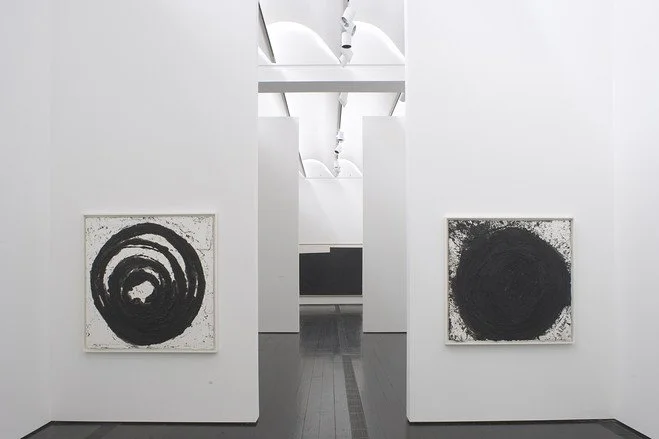
(Left) Black Tracks, 2002. Paintstick on handmade paper, 51 1/4 x 50 inches. Courtesy of Menil Drawing Institute.