

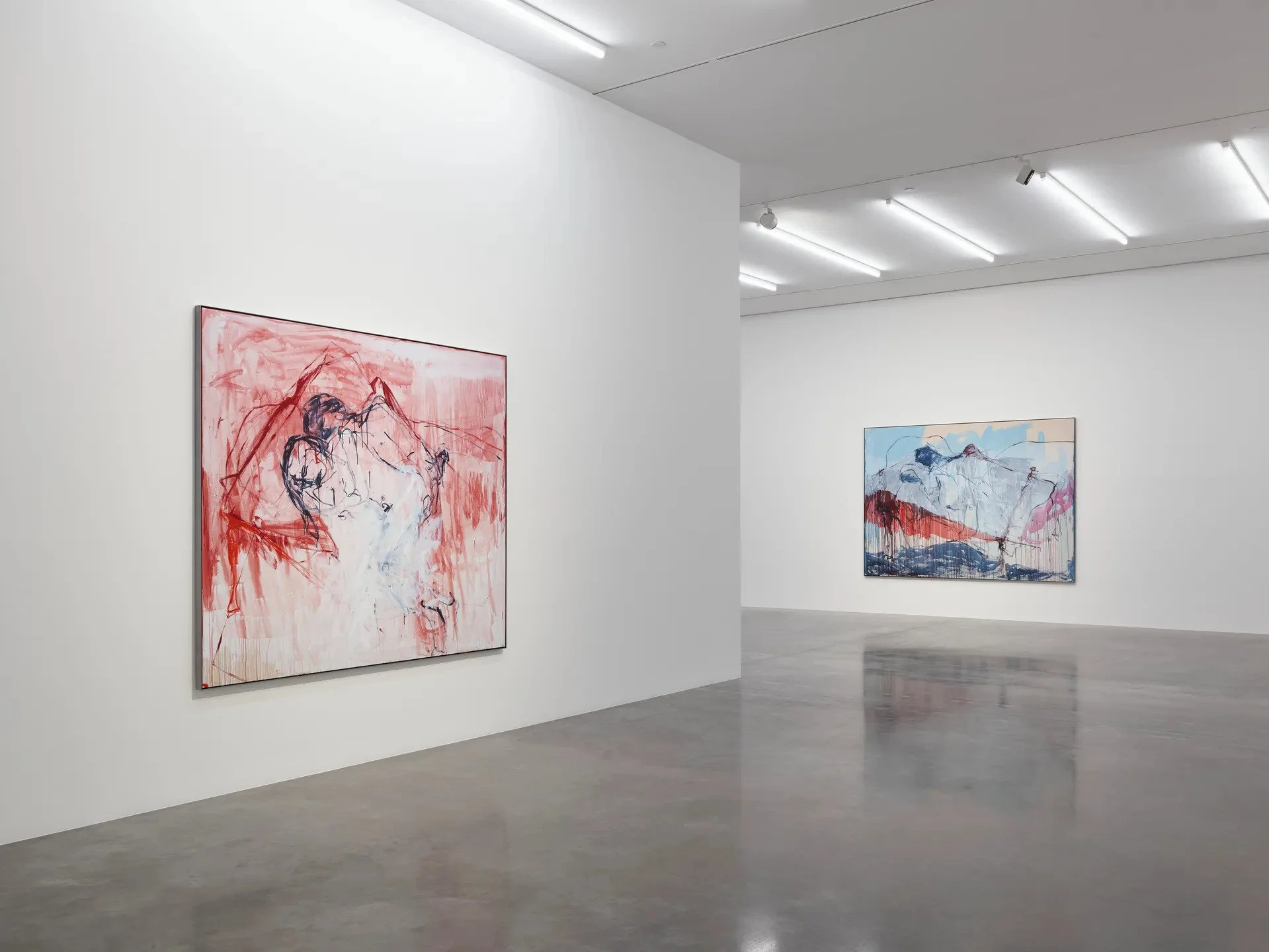
Blood-Blood and More Blood, 2024. Acrylic on canvas. Courtesy of White Cube.
Tracey Emin: The Exhaustion of Confession / I followed you to the end
White Cube Bermondsey, September 19 – November 10, 2024
The problem with Tracey Emin isn't that she reveals too much but that she reveals the same things, endlessly, profitably, professionally. For thirty years, she's mined the same trauma—the rape at thirteen, the abortions, the drinking, the bad lovers—with diminishing returns and increasing prices. The new exhibition at White Cube, centered on work made after her 2020 cancer diagnosis, promises fresh territory but delivers familiar goods: red paint as blood, handwritten text as authenticity, female figure as wound. The formula hasn't changed; only the medical details have updated.
I first encountered My Bed in 1999 at the Tate, where a man in a Barbour jacket kept repeating, "She's taking the piss, and they're all lapping it up!" He wasn't wrong, though perhaps not in the way he intended. Emin had discovered something genuinely radical: that trauma could be transformed directly into cultural capital, that confession could bypass criticism, that vulnerability could be weaponized against anyone who questioned its value. The bed—with its stained sheets, empty bottles, used condoms—wasn't just displaying private squalor but establishing a new economy where pain equals authenticity equals value.
But here's what disturbs me: Emin's work operates like a primer on feminism for those who've never questioned what feminism might actually demand. It provides just enough "female experience" to feel progressive while requiring no structural analysis, no political engagement, no challenge to power. The paintings offer vulnerability as endpoint rather than starting point—as if displaying wounds is itself revolutionary rather than asking why women are wounded, who benefits from that wounding, how systems perpetuate it.
Standing before I Followed you to the end (2024), I watch women photograph the handwritten text: "You made me like this. All of you – you – you men that I so insanely loved so much." The immediate identification—"This is exactly how I felt"—troubles me. Not because the feeling isn't real but because Emin's work stops at feeling, never pushing toward analysis. Why did you love them insanely? What structures taught you that insane love was your role? The paintings provide catharsis without consciousness, recognition without reckoning.
The work's formal qualities reveal deeper limitations. In I Kept Crying (2024), the red paint flows from the figure's torso in parallel drips, each one uniform in width, stopping at exactly the same point above the canvas bottom—controlled spontaneity that contradicts its emotional claims. The figure's outline uses the same wavering line Emin's employed since the '90s, a signature gesture that's become mannered through repetition. Compare this to Marlene Dumas, who uses similar wet-into-wet techniques but allows genuine accidents—paint pooling unpredictably, colors bleeding beyond intention, bodies dissolving into ambiguity rather than resolving into archetype. Dumas's bodies become uncertain; Emin's always conclude as "wounded woman."
The class dynamics demand examination. Emin's working-class Margate background gets endlessly cited as authenticity credential, but her work now speaks primarily to women who summer in the Hamptons, who can afford therapy twice weekly, whose romantic disappointments happen in second homes. The rawness that once felt genuine—sleeping in a bed for weeks, too depressed to change sheets—has been aestheticized for collectors who'd never tolerate actual squalor. The working-class experience becomes exotic commodity for middle-class consumption, trauma sanitized for Chelsea galleries and Mayfair townhouses.
Written by / @claroconcetto
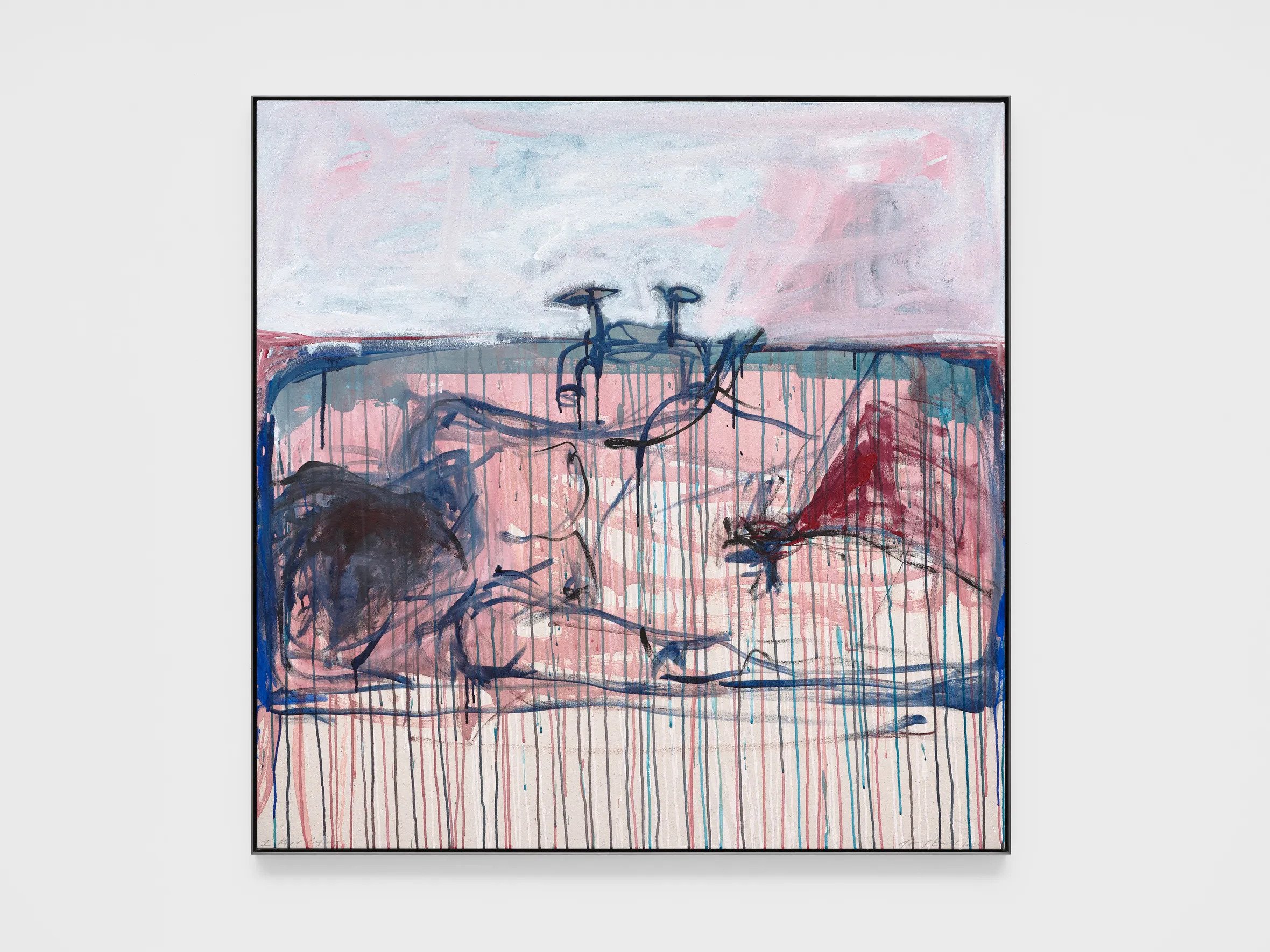
I Kept Crying, 2024. Acrylic on canvas, 122.3 x 122.3 cm. Courtesy of White Cube.
The stoma works crystallize this commodification. Here's genuine bodily reconstruction—surgical intervention creating new opening, daily maintenance of medical reality. The video documentation shows the sunset-red opening with clinical directness, viewers sitting in White Cube's darkened screening room like they're watching experimental film rather than medical documentation. But even this radical alteration gets processed through Emin's established framework: another revelation, another vulnerability, another thing to display. The stoma could open questions about bodily autonomy, about who decides what bodies should do, about the violence of medical intervention even when life-saving. Instead, it becomes another confession, another way to say "look at my pain" without asking why pain becomes women's primary cultural currency.
The End of Love (2024) demonstrates creative exhaustion disguised as evolution. The cats occupy an empty bed—absence where presence was, the millionth iteration of this visual metaphor. But look at the paint handling: the Turkish rug patterns are painted in flat acrylic over oil, sitting on the surface rather than integrating with the composition. The blue geometric shapes use a different paint consistency than the pink areas, creating unintentional separation between elements that should cohere. This isn't mixed media experimentation but technical confusion, an artist filling space without understanding why.
The bronze sculpture I Followed You To The End (2024) fails entirely as three-dimensional form. The surface treatment—rough modeling with finger marks preserved—might work at intimate scale, but blown up to institutional proportions, these marks become grotesque rather than tender. The bronze itself, with its traditional associations of permanence and monumentality, contradicts everything vital in Emin's earlier work. The piece doesn't explore space but occupies it through sheer mass, like a corporation claiming public plaza through oversized logo.
What frustrates me most is how Emin's work forecloses other possibilities. Her market dominance means she becomes the representative for "women's experience in art," but which women? The women who find recognition in her work share specific characteristics—middle-aged, educated, with cultural capital to enter White Cube, economic capital to consider purchasing prints, temporal capital to spend Tuesday afternoons contemplating their romantic disappointments. The specificity gets universalized through institutional validation, as if all female pain looks like Emin's particular performance of it.
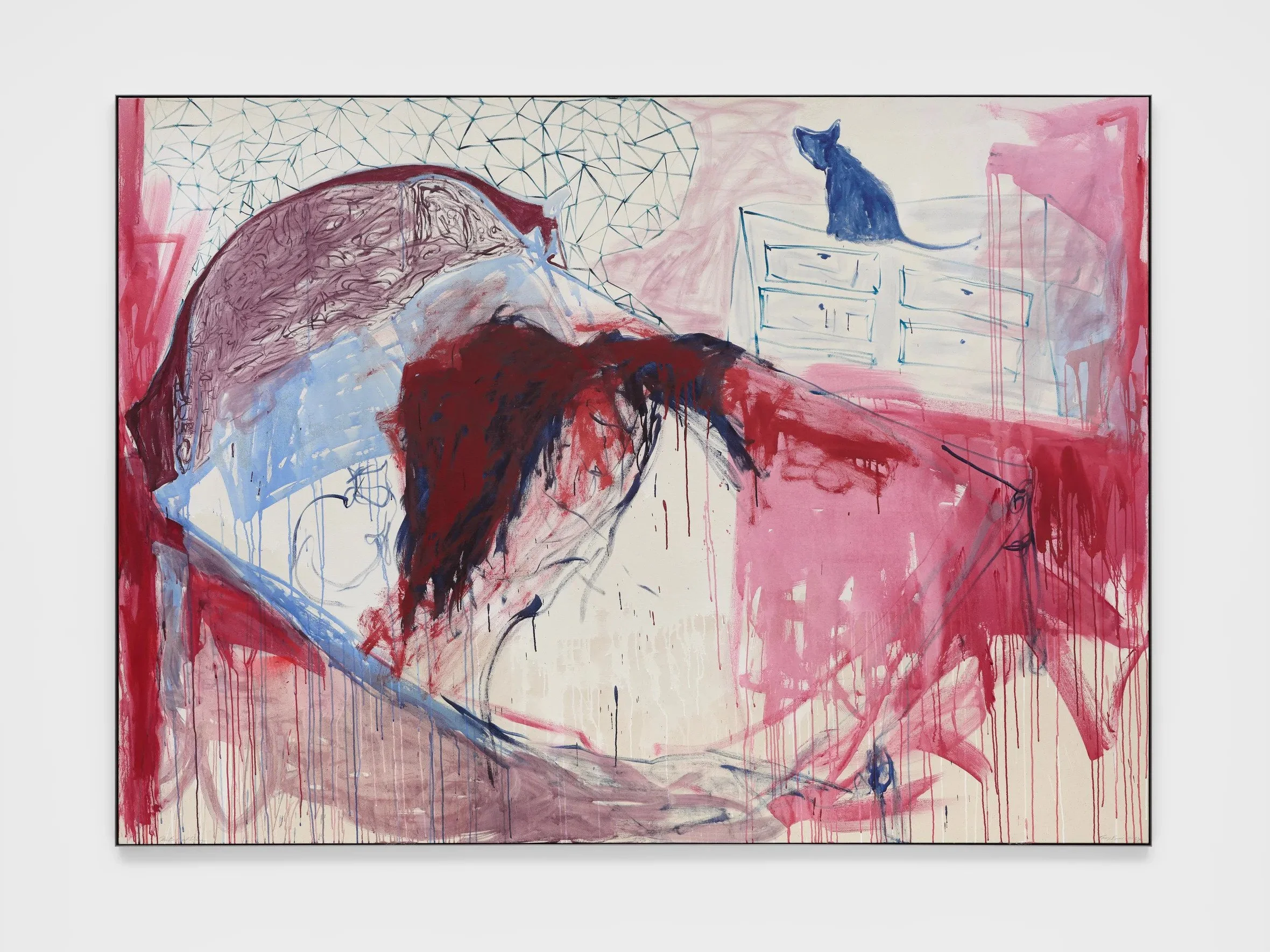
The End of Love, 2024. Acrylic on canvas, 202.9 x 280.2 cm. Courtesy of White Cube.
Consider how differently other artists approach similar territory. Kiki Smith uses bodily imagery to explore porousness—between self and world, human and animal, sacred and profane. Her figures leak and transform but toward connection rather than isolation. Sarah Lucas deploys humor to weaponize vulnerability—her soft sculptures make bodies absurd rather than tragic, forcing viewers to confront their own discomfort with flesh. Even Cindy Sherman, working through pure artifice, reveals more about female experience by refusing autobiography entirely, showing how "woman" is always performance, always constructed, never natural.
Emin's philosophy reduces to "honesty is beautiful, even when painful." But this assumes honesty is possible, that confession equals truth, that revelation equals authenticity. The work never questions its own terms, never considers that confession might be another performance, that vulnerability might be privilege (who can afford to be vulnerable?), that pain might be commodity. The paintings assume their own radicalism while operating entirely within established systems.
The audience dynamics reveal the work's actual function. On my third visit, art students sketch the bronze sculpture while their instructor explains how it "challenges traditional representations." But sprawled legs aren't challenge—they're the oldest representation possible, woman as essentially open, available, penetrable. The scale changes nothing except price point. These students are learning that feminist art means displaying female damage rather than analyzing systems that create damage, performing vulnerability rather than building strength.
Young women pose with the paintings for Instagram, their bodies echoing Emin's dissolutions. They're absorbing the lesson that female creativity requires confession, that authenticity means exposure, that value comes through vulnerability performed for public consumption. This pedagogy troubles me—not because vulnerability can't be starting point but because Emin's work presents it as achievement, endpoint, arrival rather than departure.
The gift shop makes the operation explicit. A woman buys three postcards of I Followed you to the end, explaining to her friend, "My daughter's going through a breakup, these will help." Help how? By confirming that breakups hurt? By validating pain without examining why romantic disappointment becomes existential crisis specifically for women? Why women are taught their value depends on being chosen? The postcards offer feeling without framework, emotion without analysis, recognition without revolution.
Another Place to Live (2024) almost escapes these limitations. Here, paint leads rather than follows—blues crashing against pinks through actual material interaction rather than predetermined composition. The black lines build through accumulation rather than description, creating architectural space through mark-making rather than illustration. For these moments, Emin stops performing Tracey Emin and lets painting think through its own logic. But these passages remain exceptions, brief glimpses of what might have been possible if success hadn't frozen her into endless repetition.
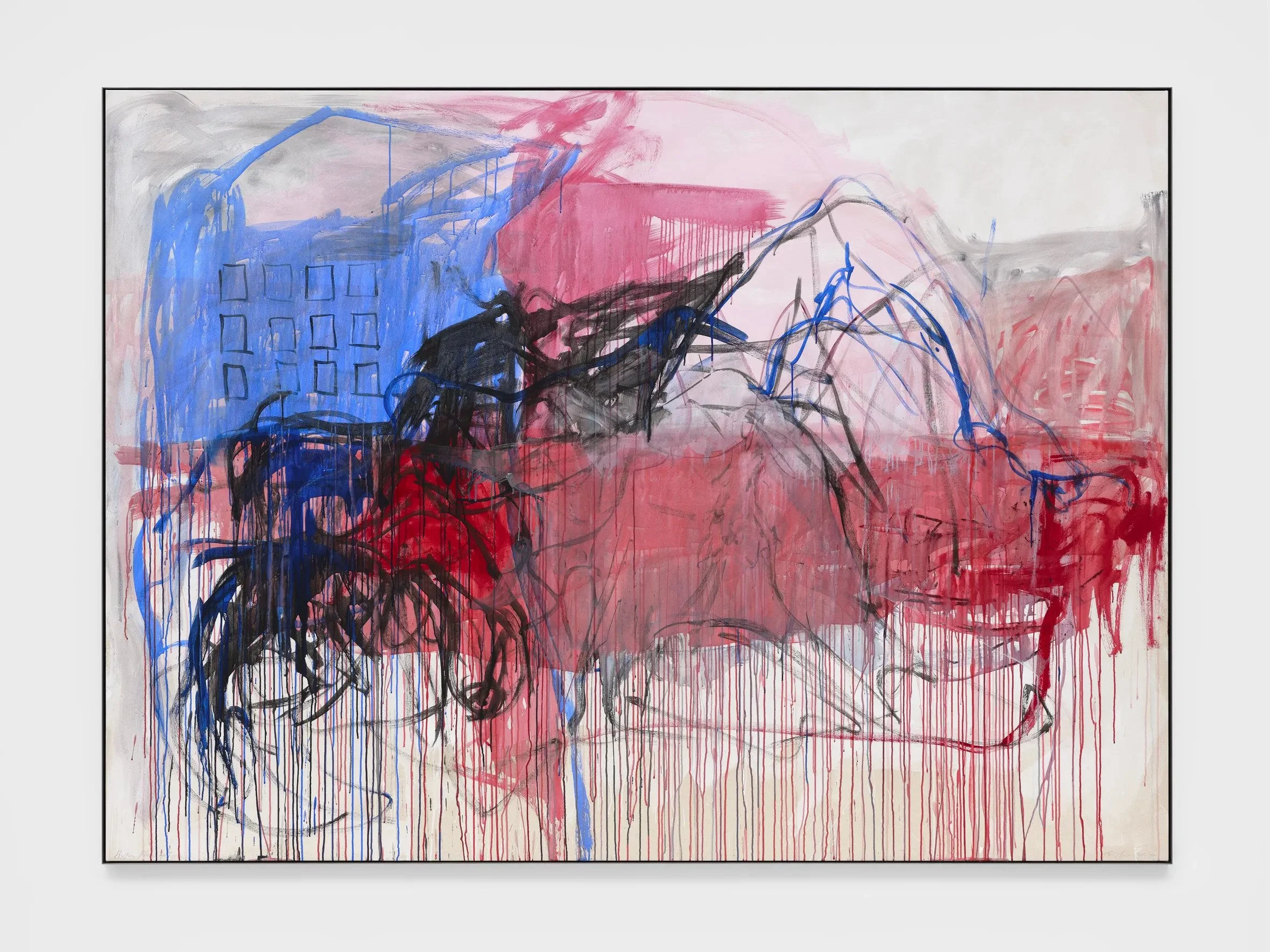
Another Place to Live, 2024. Acrylic on canvas, 122.3 x 122.3 cm. Courtesy of White Cube.
Walking through White Cube—that refrigerated space where rebellion gets preserved in perfect climate control—the installation reveals its own contradictions. Each painting hung at optimal height for photography, lit to eliminate shadows that might complicate viewing, spaced to allow circulation but prevent contamination between works. The spontaneity has been choreographed, the confession scripted, the vulnerability stage-managed. This isn't curatorial failure but revelation of what the work always was: professional performance of unprofessionalism, institutional display of anti-institutional gesture.
The critical establishment's protection of Emin reveals the deeper problem. Any questioning gets deflected through accusations of misogyny, as if her gender places her beyond critique. But this protectionism is itself sexist—suggesting women's work can't withstand rigorous analysis, needs special pleading, requires lowered standards. The real misogyny is accepting Emin's limited vision as sufficient representation of female experience, as if women's lives contain nothing beyond romantic disappointment and bodily trauma.
The tragedy isn't that Emin reveals too much but that her revelations reveal so little—about power, structure, systems. The work provides emotional verification while never pushing toward political consciousness, offering recognition without revolution, catharsis without change. After thirty years, we're still in the introductory course, still learning that women have feelings, still discovering that pain exists, still performing surprise that female experience might matter.
This is what frustrates me most: Emin had genuine opportunity to radicalize how trauma gets discussed, how female experience enters cultural space, how vulnerability might become strength rather than product. Instead, she chose the easier path—performing damage for those who prefer their feminism digestible, their politics personal, their challenges comfortable.
The paintings document not ongoing investigation but endless repetition. They're primers for those taking first steps toward considering female experience as worthy subject matter—but after thirty years, shouldn't we have graduated to more complex texts? The work exhausts the space where more challenging work might flourish, provides just enough feminism to inoculate against actual feminist demand, offers feeling as substitute for thinking.
Leaving White Cube, I think about all the artists whose work doesn't get institutional support because they refuse confession, complicate rather than confirm, investigate rather than illustrate. Emin's success hasn't opened doors for them—it's created expectation that female artists perform similar vulnerability, provide similar content, maintain similar emotional availability for public consumption. Her victory is their limitation, her formula their prison, her success their ceiling.
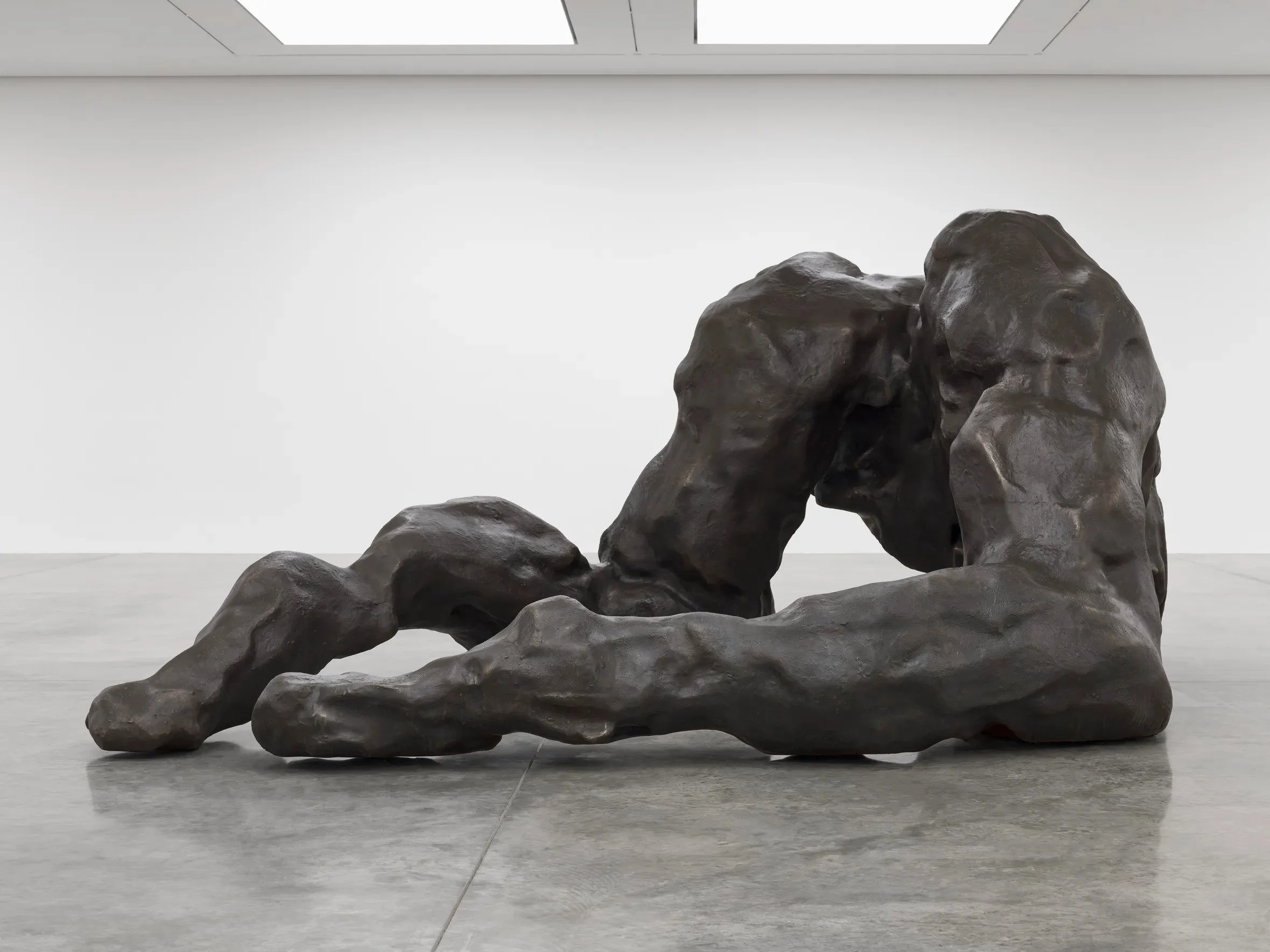
I Followed You to the End, 2024. Patinated bronze, 690 x 393 x 260 cm. Courtesy of White Cube.